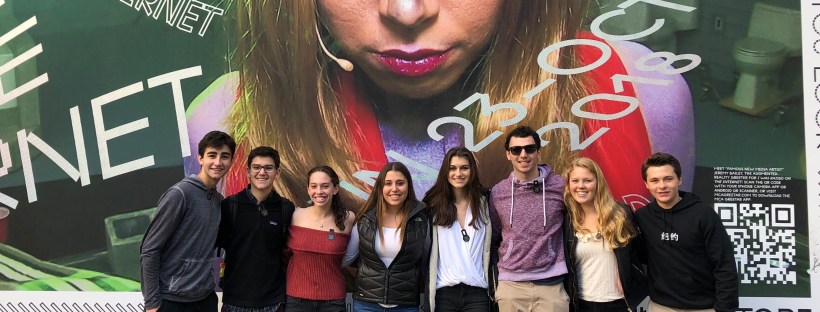
On Sunday October 14th, I was awakened early in the morning by the harsh honking of my alarm. However, on this day the blasting noise didn’t bother me; I was about to go for a 40 minute drive with my friends. Drew, Hannah, Spencer, Jack, Jared, Maggie, Corey, and I were traveling into the heart of Chicago to visit the Museum of Contemporary Art.
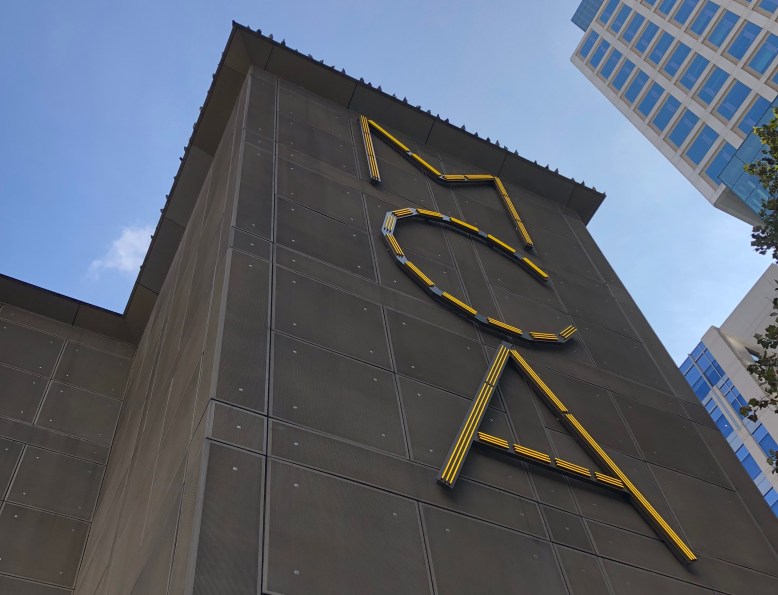 A front view of the Museum of Contemporary Art.
This was the last day that the MCA was showing I Was Raised On the Internet – an exhibition reflecting on the prominence of technology in our lives. Since we were some of the last viewers at this exhibit, we wanted to actively experience the artwork to our best ability.
Before entering the extravagant and momentus building, we stopped at the Water Tower Place to fit in a quick lunch. During this meal, I couldn’t help but already notice technology’s heavy influence. Nearly all of my friends were scrolling and swiping on their phones rather than enjoying face-to-face conversation. I hoped that the exhibit would shed light on the societal dependence on virtual interaction and digital entertainment.
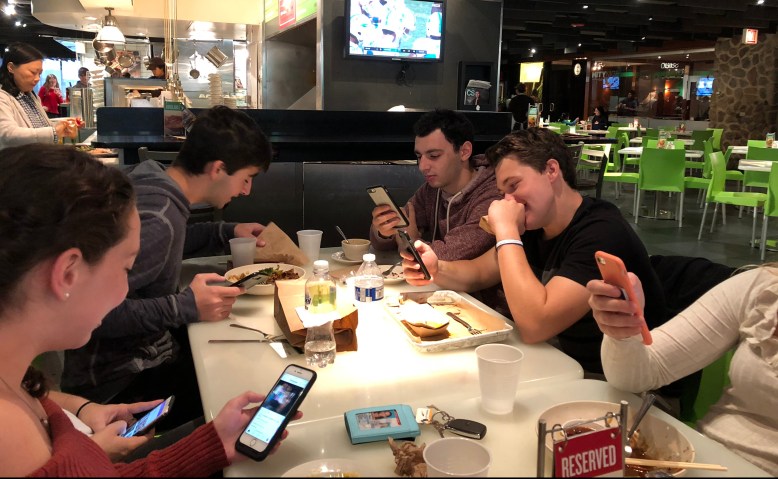 Drew, Corey, Jack, Spencer, and Hannah all on their phones while we ate lunch.
Upon our arrival, we ran up the stairs into MCA. We were allowed to explore the museum without charge, since we were all students. We then set our sights forward to fully dive into the artwork without hesitation or distraction.
The exhibit was divided into five portions, each representing different effects of technology on society. The first section was Look At Me, which emphasized how social media has caused us to fabricate the glamour of our lives. A piece that immediately grabbed my attention was titled Self Portrait: November 1, 2017.
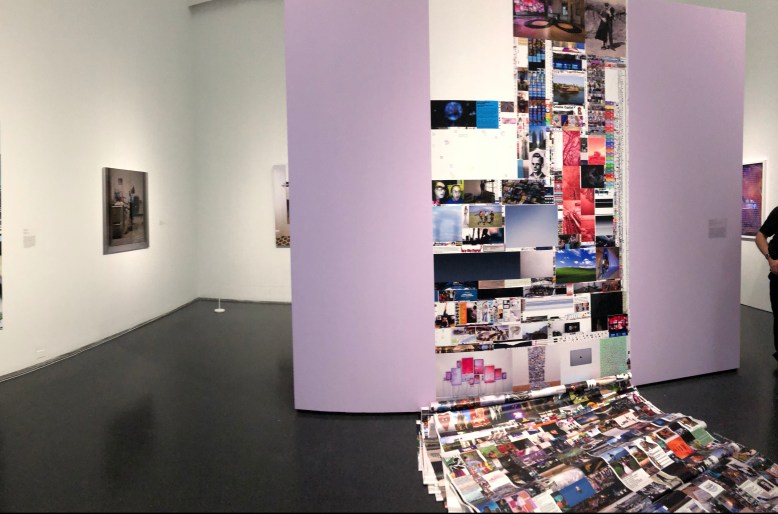 Evan Roth’s Self Portrait: November 1, 2017.
This piece depicted an entire printout of a user’s single day on social media. The overflow of photographs, web searches, and snapshots of video clips allowed us to intrude on an individual’s digital engagement. This piece contradicted a pattern among most social-media users today. Rather than performing on social media, the user fully exposes his or her digital profile, which the artist recognizes as a self portrait: a true reflection of the user’s self. This personal examination embraced the good, the bad, the embarrassing, and the fascinating. On social media we hardly encounter individuals that truly display their lives, so this rarity of authenticity alerted and taught me that it is acceptable to be honest online.
Next came Touch Me, which represented how society’s transition to a technologically dominated world altered our perceptions of reality. This section showed how human experiences, like feeling and seeing, can be limited or enhanced on the internet. In this section, there were two holographic photos that caught my eye.
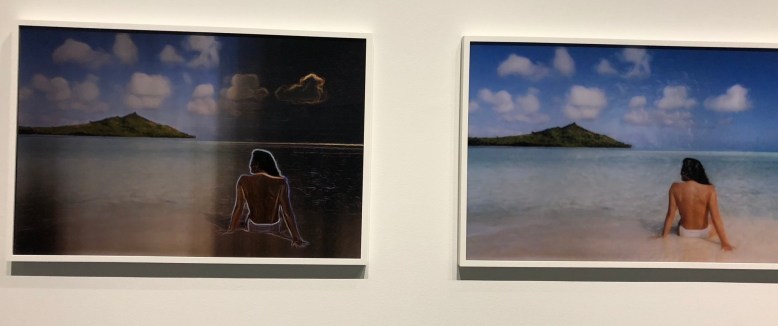 Constant Dullaart’s Glowing Edges_7. 10 and Plastic Wrap_20. 15. 15 from the series Jennifer in Photoshop, Creative Suite 6.
Modern photoshop was applied to each photo; the photo on the left was saturized to emphasize the coloration, while the photo on the right was softened – as if it were covered in plastic. These holographs showed how editing plays a heavy role in digital photography and ultimately distorts the viewer’s understanding of reality.
Afterwards, we traveled through Control Me, which analyzed how large powers, such as our government and security entities, use technology to manage or infiltrate our lives. During this section, the piece that particularly stood out to me was Please Empty Your Pockets, which was more interactive than it was visual. Here, participants placed their hand-held belongings (no matter how embarrassing or personal) on one end of an airport-style conveyor belt and watched the scanner record and store all of the information that passed underneath it.
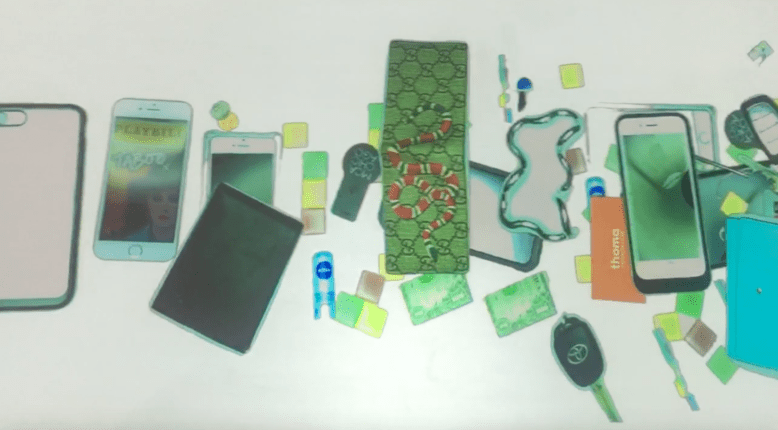 Rafael Lozano-Hemmer’s Please Empty Your Pockets feature at the Museum of Contemporary Art.
This realistic machine caused me to question the extent to which our security services are protecting us or obstructing our privacy. New technology allows groups like the TSA to hold power over the general public and see into parts of people’s lives that they may not want to share.
Next came Play With Me, in which viewers have the opportunity to interact with the artwork through new technology. In this portion of the exhibit, I was immediately struck by the Transdimensional Serpent. The structure utilized virtual reality to digitally place the viewer into a high-tech world filled with obscurity.
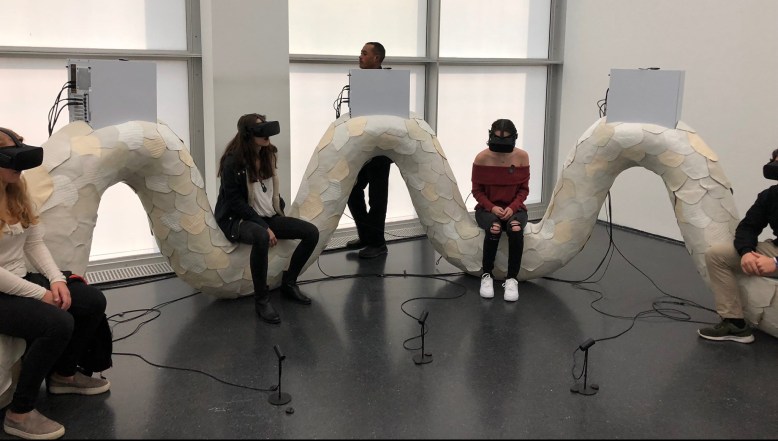 Maggie, Drew, Hannah, and Spencer experiencing Jon Rafman’s Transdimensional Serpent virtual reality at the Museum of Contemporary Art.
I timidly took a seat on the 20 foot serpent and began experiencing this piece for myself. I saw thousands of unique bodies marching in rows on a gridded surface. I also was dropped into a dark alley, being approached by three tall silhouettes. At the moment they were about to confront me, the were disrupted by a screen of computer coding. When I returned to reality with a gaping jaw, I was utterly confused and alarmed.
I reflected for a while on this experience and came to realize its many facets. The thousands of marchers portrayed the recent surge of internet users, anonymously making an impact on society. The three silhouettes and the computer screen represented how human interaction is blatantly shielded by technology. Overall, this experience captured the ambiguous and limiting aspects of the internet in a cohesive, yet ambiguous manner.
Finally, we floated through Sell Me Out, which highlighted how companies use and abuse the internet for brand-advancements. One piece that captured these ideas was The Litany, which had an individual room dedicated to it. When I walked in, I saw a large screen on top of a pile of sand filled with flickering devices.
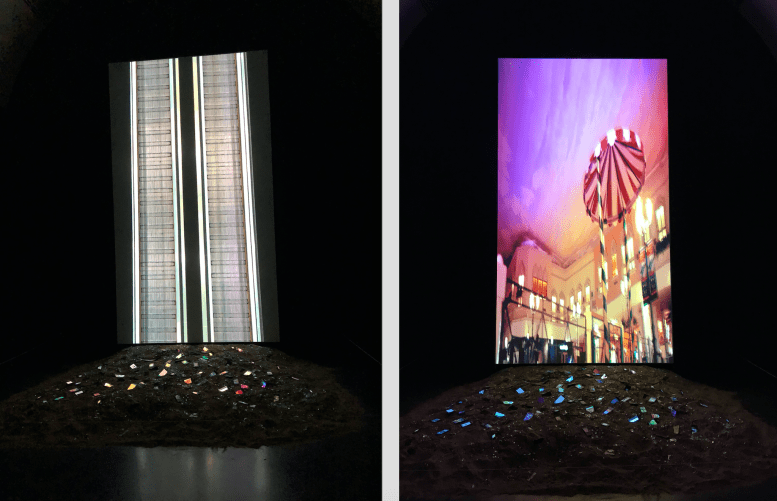 Sophia Al-Maria’s The Litany at the Museum of Contemporary Art.
A video played, involving a rollercoaster ascending and a woman traveling through a futuristic mall. By the end of the short film, I watched her deteriorate because of the overbearing brand marketing, which emphasized the digital control that corporations have over consumers.
Overall, my experience visiting I Was Raised On the Internet allowed me to thoroughly consider my social responsibilities as a person in the age of the internet. I became more aware of how technology alters human interaction, limits authenticity, and is sometimes danger to the general public.
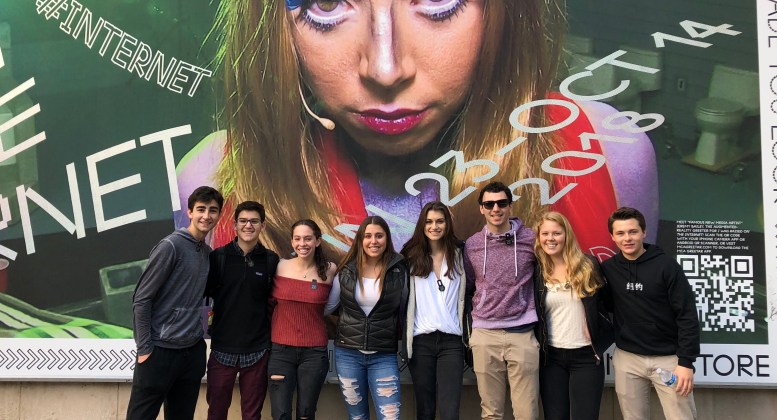 Corey, Jared, Drew, Maggie, Jack, Hannah, Spencer, and I after attending I Was Raised On the Internet at the Museum of Contemporary Art.
On the drive home, my peers were no longer glued to their devices. Rather, we had a meaningful conversation about the influence technology in our lives. I immediately noticed a spark of change within my friends and myself. Although the exhibit is no longer at the Museum of Contemporary Art, I strongly recommend that other teenagers and students research or consider the weight of technology in their lives.
 Sami's Social Speculation