
Imagine that you’re ten years old, playing a board game with your friends and family. Maybe you’re playing Monopoly or The Game of Life, but regardless you’re calculating the intricate route you must take to beat your opponents. Skipping your pawn from space to space, you are not entirely sure where you will end up, but you continue to move. You aimlessly follow each random command and do not try to change the rules of the game.
The process of playing a board game unequivocally reflects the cyclical environment of gang-life in Chicago. People succumb themselves to the underlying forces that guide their behaviors and motives. Players move from space to space with an end goal almost too far ahead that it feels fictitious.
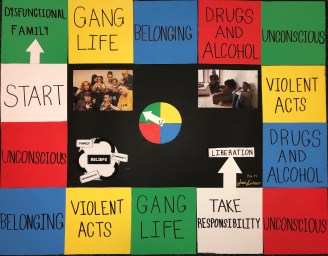
My mashboard depicting the game of gang-life.
First, one must decide to play the game of gang-life. This decision allures teens who grew up in a neighborhood that is plagued with violence and gang involvement. The initial exposure then invites them to recognize gangs as a “way out” of their struggles. Once individuals begin on the path toward gang-life, it is hard for them to turn around. They continually flick the spinner and move to a new space.
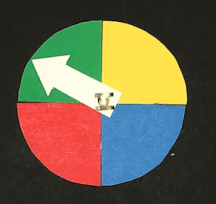
The spinner on my mashboard.
The spinner on my mashboard reflects the unpredictability of gang-life. People who play the game must blindly spin away and see which color they will land on. More often than not, there is a general cycle that individuals undergo once they immerse themselves in gang-life. Former gang member Edwin Day explained that people exposed to gangs early on are usually “young people looking for something to gravitate toward – that feeling of ownership or belonging” (NPR). Most people who join gangs come from dysfunctional homes and long for a sense of acceptance and love.
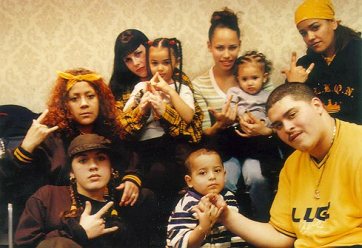
An image depicting the family-like environment of gangs. Photo by Gang Enforcement.
Reymundo Sanchez, author of My Bloody Life, was drawn to the Latin Kings, a ubiquitous gang in Chicago. He initially chased respect from his King brothers, but once his involvement deepened, Sanchez started to follow the dangerous path presented to him by his leaders. He abused alcohol to gain courage to go on shooting sprees, which in turn made him feel accepted on a greater scale. His repetitive behaviors masked his shame for the world he was involved in. He became unconscious and struggled to regulate his actions – ultimately perpetuating a loop that is difficult to end.
This repetitive journey depicts how socialization urges people to join and stay in a gang. In The Cycle of Socialization, author Bobbie Harro highlights how our families, neighborhoods and institutions force certain ideals upon us. On my mashboard, I created a graphic representing this process. By placing this graphic toward the “end” of the game board, viewers can visually understand how gang-life cycles again and again. The arrows on the visual lock this process in, emphasizing the cycle and near-permanence of gangs.
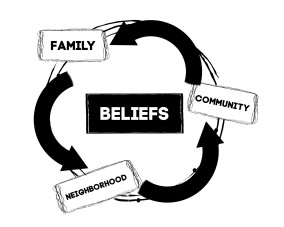
A graphic I created to depict the cycle of socialization.
When a person joins a gang, they are immediately socialized by other members. They are directed how to think, behave and represent their gang. These factors ingrain certain beliefs into a person’s mind. Once their perspective has been wired, it is very difficult for them to see beyond what they now value. Socialization within gangs heavily plays a role in the violence, drug use and unconsciousness that their members adopt.
In Chicago, this everlasting environment is incredibly tough to escape. On my mashboard, I included an individual white space with the instructions directing the player to “take responsibility” and eventually escape the game. This space is located immediately after the player becomes unconscious from their danger-filled lives since they may wake up to reality shortly after. However, it is much more difficult to land on the space than it may seem. The spinner can only land on a red, green, blue, or yellow space — never a white space. This restricted distribution method is intended to reflect the energy and bravery it takes to escape gang-life.
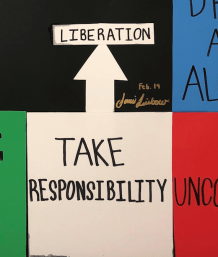
The unique space that allows a player to escape the game of gang-life.
Between the quest for belonging and the powerful force of socialization, it may appear to be nearly impossible for individuals to counteract what society expects of them. One must understand that they’ve lost control over their lives and recognize their ability to reestablish themselves beyond their gangs. In Sanchez’s case, he realized that “it’s time we take responsibility for our own neighborhoods and put a stop to the crying” (299). This mindset, despite being difficult to obtain, is crucial in order to end the cycle.
Gang-life has many complications that are often difficult to avoid. However, by recognizing our roles in its perpetuation, we can more easily put an end to the danger for its members and surrounding communities.
 Sami's Social Speculation