On a cold and windy February afternoon, fellow CST classmate Paula and I drove down to Lincoln Park to attend a local performance of Pipeline at the Victory Gardens Theater. We did not really know much about what we were about to watch, but we were very eager to see the performance and experience something we had never before.
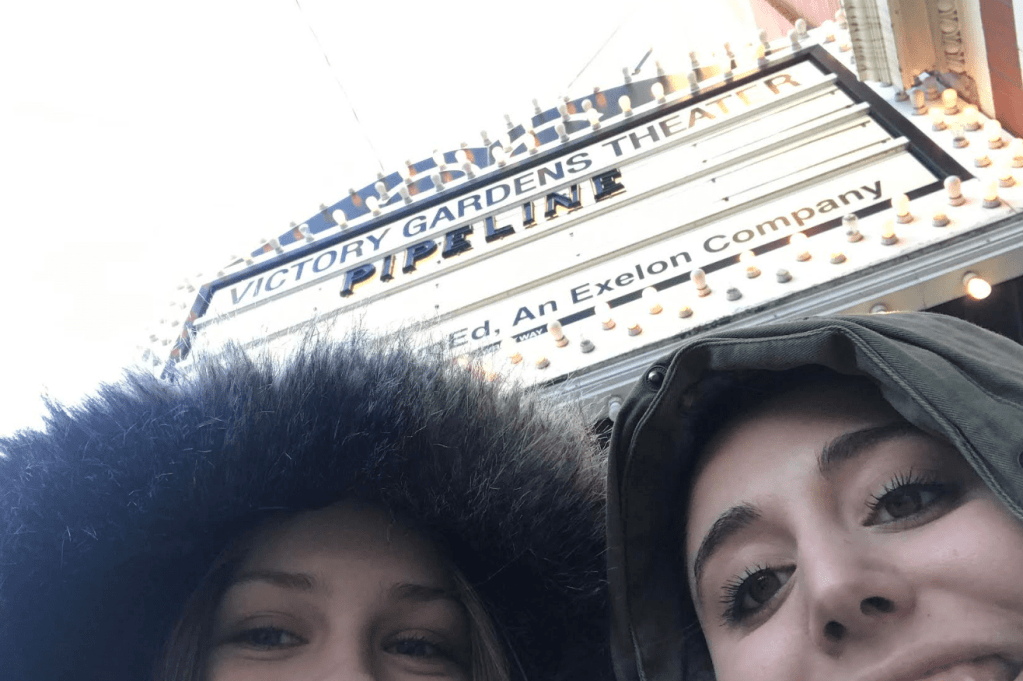
Paula and I arriving at the Victory Gardens Theater.
Throughout the play, two common themes that arose emphasized mental health and racial injustice. Omari (Matthew Elam), a black male, was sent to a private boarding school consisting primarily of privileged white people. Feeling uncomfortable as an “outsider,” he kept his guards up wherever he wandered. Whether it be a relationship with his girlfriend, Jasmine, or a relationship with his professor, he was continually tense and never quite felt at ease. Omari eventually acted out violently toward his professor for singling him out during a class lecture and displaying implicit racial biases toward him. This microaggression was the final straw for Omari, blowing him over the edge and causing him to feel heavily misunderstood.
From that point on, Omari faced expulsion by school administration, as they claimed this was the last strike. This pivotal event lingered throughout the week and led him to question his stability and happiness with his position in life. After the event, he reluctantly broke up with his girlfriend, saying goodbye to a major motivator in his life. He then attempted to run away, taking a train to another state and causing his mother great worry. These irrational and immediate decisions reflected a change in demeanor for Omari. The triggering experience greatly impacted his self concept and caused him to lose his sense of worth.
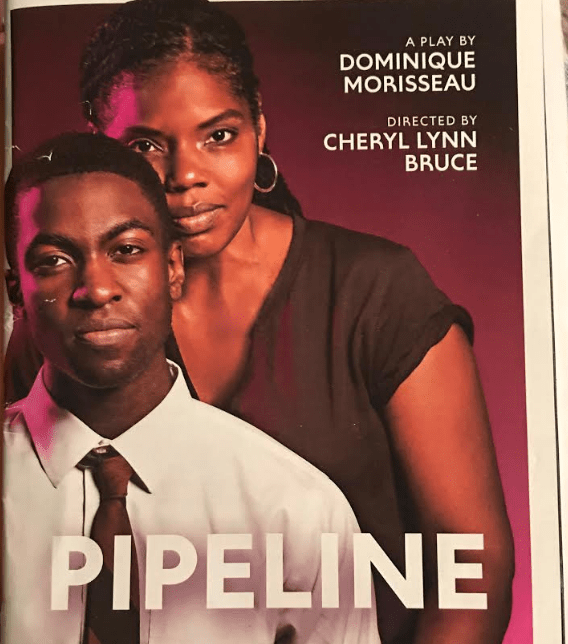
Tyla Abercrumbie (Nya) and Matthew Elam (Omari) featured on the cover of the Pipeline program.
In class, we have talked about the impacts of microagressions. While to an outsider these backhanded comments may appear subtle or harmless, to the receiver they can feel excruciating (especially if they are frequently expressed). With Omari attending a school flooded with privilege, he struggled to find his place and truly feel a sense of belonging. He mentioned how many students saw him as different, and how it felt as though he was sent there to be changed. The accumulation of these comments combined with Omari’s feelings of isolation heavily influences his perception of himself, and even caused him to feel weak in the system of institutionalized racism.
Moments like these initiated the fear that Nya (Omari’s mother) had for her son, which vastly impacted her mental health. Nya (Tyla Abercrumbie) was a teacher at an inner-city public high school. She had sent her son to a prestigious boarding school, despite struggling financially and relying on her ex-husband’s payments to keep him afloat. She had long worried that he would be trapped within a sea of self-fulfilling low expectations, and her effort to provide him with elevated educational opportunities reflected her devotion to providing him with the best opportunities possible.
After hearing about her son’s mishap with his teacher, she felt an even greater tug of worry. She hunted down Omari’s girlfriend and was terrified of what may happen next to her beloved son. This immense stress piled on and on, resulting in repeated panic attacks, which often occurred during her class lectures.
Many of Nya’s panic attacks stemmed from her fear for the impacts of white privilege. While reading Gwendolyn Brooks’s poem “We Real Cool” to her class, she found herself lost in the storyline as it quickly became her reality. The poem highlighted the protagonists worrying that their lives may come to an end soon and repeatedly uttering, “we die soon.” While reading this line, Nya envisioned Omari. She worried that systemic racism would kill him and that he was in grave danger. This underlying fear kept Nya up at night and severely stunted her mental sanity, thus emphasizing the correlation between mental health and white privilege.
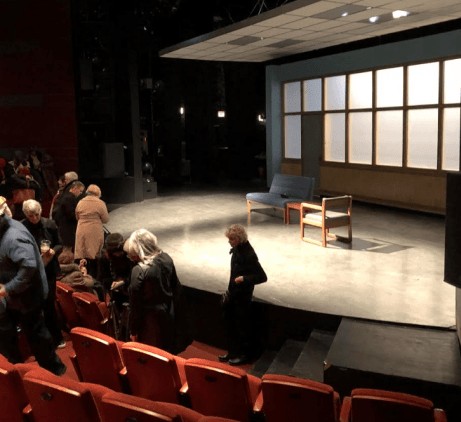
The intimate stage at the Victory Gardens Theater.
In class, we have read many texts emphasizing the cycles that perpetuate white privilege and suppress black people. In The Fire This Time, author Jesmyn Ward highlights how black people remain target groups and how for centuries we as a nation have accepted this notion. She explains that it is time to bounce back since, “We’re tired of having to figure out how to talk to our kids and teach them that America sees them as less, and that she just might kill them” (9). Ward describes a conversation held in many black households – one that white people would never have to consider. This conversation demonstrates why Nya wanted to catapult her son into a more opportune environment; however, in doing so, Omari repeatedly battled the stereotypes surrounding him and gradually lost his strength.
Pipeline emphasized many of the concepts we have learned in class, but also shed a new light on the issues on a more personal level. In class, we have talked extensively about how institutionalized racism is still very evident in today’s world, especially within the education system. However, Pipeline showed how this struggle weighs on people’s perceptions of themselves (and ultimately impacts their mental well-being). I thoroughly enjoyed seeing the performance, and it led me to question how minorities at GBN may be impacted by white students exercising their privilege or displaying microaggressions. I would highly recommend other CST students to attend this play; it was very impactful and disturbing.
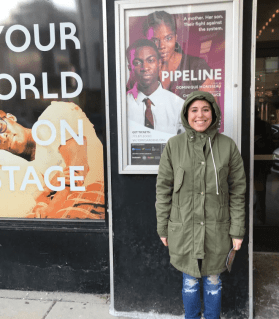
A photo of myself all bundled up after seeing the incredible performance of Pipeline.
 Sami's Social Speculation