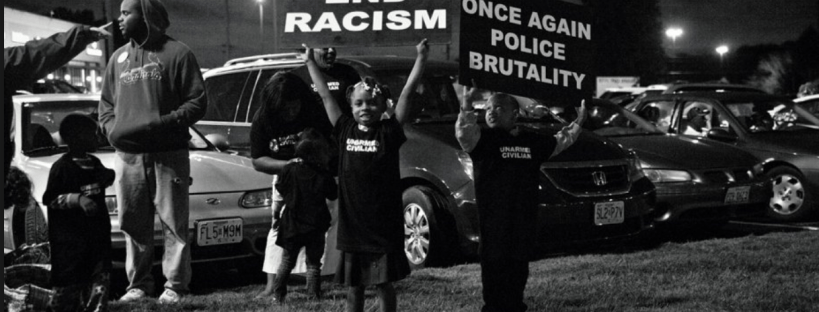
Hundreds of years ago, our country was founded on the grounds of freedom. Citizens celebrated the privilege and potential for opportunities, but ignored the injustice right in front of them. Slavery dominated society, and white males in power didn’t shed light on the extreme prejudice lurking. For the years following, they continued to be the decision-makers and allowed the oppression of black people to endure. Over time, social leaders wanted to maintain their status, and those who faced prejudice struggled to find their voice. Invisible systems today, such as the justice system and white privilege, create an illusion of justice. This illusion persists as powerful individuals continue to hold their status and attempt to undermine the rights and capabilities of African Americans.
The justice system within itself demonstrates a false appearance of fairness. Police officers and court officials hold the power to alter the freedom of all people. From an outside perspective, it may appear as though everyone is given equal rights. However, because of the discrimination brought on by these authority figures, black people are at a substantial disadvantage.
In Citizen: An American Lyric, Claudia Rankine emphasizes these injustices by juxtaposing how white and black violence are distinctly recognized within the justice system. She highlights the death of James Craig Anderson, who was ran over by a group of white boys driving a white pickup truck. Rankine describes, “The announcer patronizes the pickup truck, no hoodlums, ‘just teens,’ no gang, ‘just a teen…’ The pickup is human in this predictable way” (Rankine 94). In this instance, the boys were not initially considered as convicts because of their appearance. In the eyes of the announcer, they were harmless teenagers. This contradicts the treatment of the Jena Six, who faced racist attacks and were charged for physically abusing a white boy (Rankine 101). Contrary to the group in the pickup truck, the Jena Six immediately were under scrutiny. While the white boys were overlooked in the face of criminality, the black boys were dehumanized and, thereby, villainized. This discrepancy reveals the racial bias within the justice system, and with white people in power, these biases become especially difficult to reverse.
The basis on which the policing system is structured puts African Americans at a disadvantage innately. Officers learn to identify certain individuals as threatening or not. In reality, most of these officers place racism in their arsenal of weapons, and they frequently use it to frame black people as dangerous, and in their eyes, justifiably targeted. This approach of Street Calculus, coined by Garry Trudeau, demonstrates how individuals rapidly stigmatize black people such that privileged whites see them as dangerous.
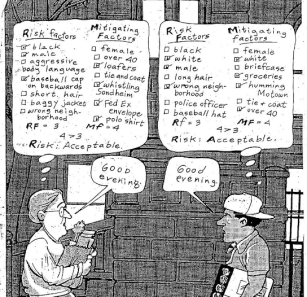
Street Calculus by Garry Trudeau.
Because of immediate assumptions, men like Trayvon Martin and Michael Brown were fatally shot by authority figures purely for being black; those who committed the murder were not rightfully condemned by the justice system for their infringement of civil rights. This swept-under-the-rug approach causes black people to continue to be convicted or shot for crimes or dangers that they aren’t responsible for. These injustices have inspired individuals to form the Black Lives Matter movement (as of 2014) to bring attention to the extreme inequality throughout the justice system. However, attempts by politicians and powerful individuals still undermine the vulnerability of black people in the face of white authority, which further hides the injustices.
Moreover, this illusion of justice emanates from what we learn from our families, friends, media outlets and community institutions. Each of these figures teach us certain ideals that influence our actions and perceptions of society. In The Cycle of Socialization, Bobbie Harro explains how this process of forming a societal exoskeleton around authority develops agent groups (the powerful) and target groups (the powerless). She discloses how these roles influence societal norms: “People with power have gained it through the existing system. It is difficult to risk losing it by challenging that same system…As long as we are ‘living’ in the Cycle of Socialization with the core themes holding us there, it will be difficult to break out of it” (Harro 51). Because agent groups work to maintain their position of power, they often deflect attention away from clear examples of racism, thus displaying an illusion of justice. By placing blame or degrading target groups, those with power can disseminate their prejudice so that it becomes a commonly accepted perspective.
Many white people maintain their position of authority by spewing “accidental” microaggressions. These microaggressions nip at African Americans, with each bite hurting worse than before. From a privileged perspective, these comments don’t seem harmful because they are subtle. However, they are often delivered by white people who rarely receive them. Whether it be implying that all black people are inadequate writers or calling the police on a black person who is purely watching their friend’s child, the message behind each microaggression attempts to keep African Americans down while wearing a mask of integrity. White people often rationalize these comments to shield their racism; they “assume innocence, ignorance, lack of intention, misdirection” (Rankine 83). By acting as if they have disconnected the meaning from the words, people try to diminish their responsibility over their actions, which thereon perpetuates the illusion of justice.
More explicitly, this illusion of justice is concealed by the rise of media. One-sided news outlets often present black people as perpetrators, but they hardly recognize clear instances of racism in which white people are at fault. Rankine introduces this concept by recognizing the media’s attempts to demean Serena Williams. After numerous incorrect calls in a 2004 US Open match, Serena lashed out at the line judge (who was being unjust) and attracted negative publicity (Rankine 29). The American media framed Serena’s behavior as villainous, ultimately causing viewers to be more intune to her actions and associate them with her race. By presenting the wrongdoings of primarily one group, viewers develop negative perspectives about its members and begin to view themselves as the victim. These assumptions cause white people to try to reclaim their power and resubscribe to their position in an agent group.

Serena Williams at the 2004 US Open.
Both the justice system and agents of white privilege maintain the image of equality through their attempts to suppress their wrongdoings and emphasize those of African Americans. Until we as a society can recognize that we are believing an illusion, it will continue to hypnotize us. We must shed light on our mistakes and work toward an environment in which we all can feel acknowledged. Although it may be difficult to rewrite a system that we have lived by for so long, it is necessary to eradicate our unjust assumptions for the sake of all citizens.
 Sami's Social Speculation
I really like your connections to “Street Calculus”. Very well written and thought-provoking!
LikeLiked by 1 person