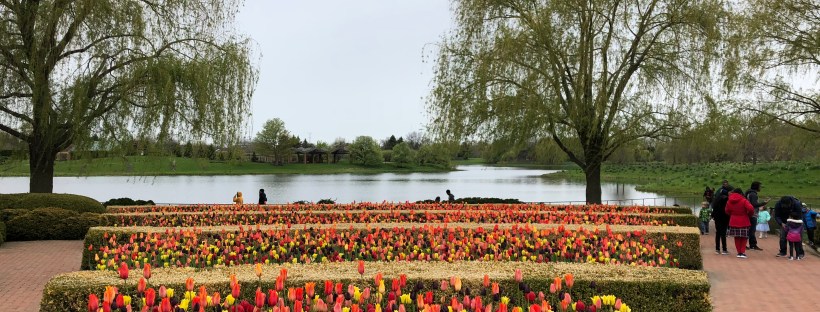
On Saturday May 11th, I drove to the Chicago Botanic Garden with my fellow CST classmate, Paula, and my friend from Humanities, Alice. We were not going to the gardens to simply admire and smell the flowers, though that was a huge benefit of the overall trip. Paula, Alice and I were attending a Climate Change Panel in the Alsdorf Auditorium led by Congressman Brad Schneider.


When we arrived, we were a bit anxious that we would not be seated since we had tried to register after the closing date, but we were excitedly welcomed by employees from Rep. Schneider’s office who helped us find a place to sit. This set the tone for an open-minded event, and I was immediately excited for what was to come.
To kick off the event, Rep. Schneider introduced himself and discussed his connection to environmental issues within his line of work. He explained that he had primarily focused on the economic side of things for a long time, but believes that environmental issues are more than important and must be addressed now. He then went on to discuss a recent UN report that was published only days prior, estimating that currently one million species are at risk of extinction. The reason this is so important to recognize, he said, is because as we lose these species, our ecosystems are at risk of collapsing, which can cause a domino effect and impact a vast amount of the life on Earth. He then emphasized how we need transformative change, including changes in transportation, food, and simply the way we live. Rep. Schneider then welcomed in the experts who would be representing the panel.
The panel consisted of three professionals within the environmental industry. First was Evan H. Delucia, a PhD and Professor of Sustainability, Energy, and Environment at the University of Illinois. He has conducted research on land, resource and water use as well as its impact on forests, grasslands, and agriculture in relation to global climate change.
Next came Angela Larson, the Community Planning Director of the Alliance for the Great Lakes. Her work primarily lies in improving urban infrastructure, such as sewage patterns, river streams and building layouts, in order to behave more sustainably and harness community networks that can work toward rapid change.
Last entered Daniel Horton, a PhD and Assistant Professor at the Department of Earth and Planetary Sciences at Northwestern University. Horton has dedicated most of his research toward analyzing climate change and is currently researching its impacts on our atmosphere and the environment with regard to extreme weather and human impact. Each of the three experts began by discussing their fields and what they believe is necessary in order for change. Rep. Schneider then asked questions to particular panelists to help deliver information to the audience.
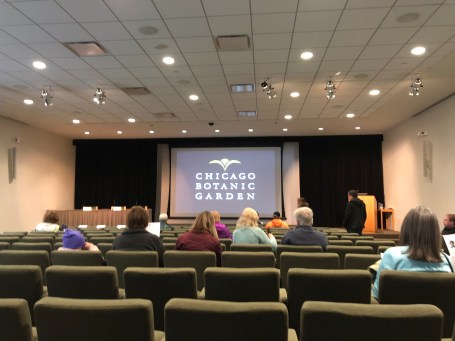
Photo of the auditorium where the Climate Change Panel was held.
To me, some of the most powerful words throughout the panel came from Daniel Horton when Rep. Schneider asked him about the impacts of climate change on national economies. Horton explained that there are three main concepts that encapsulate economics in relation to the environment.
Firstly, there are charismatic extreme events, which he described as “billion-dollar disasters” such as Hurricane Harvey or the California wildfires. These events draw massive public attention but result in immense environmental degradation that requires economic assistance. These occasions have been increasing over the past few decades as climate change has persisted, damaging the earth, humans and our economy.
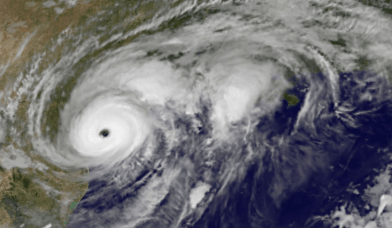
Photo of Hurricane Harvey—an event that could be considered a “charismatic extreme event”. Provided by CNN.com
Secondly, there are creeping events, which may not draw as much national attention as extreme events, but are equally as harmful in the long run. Examples of these events include the steady increase in temperature and sea level. Although these issues may not seem to be a big deal economically, they ultimately alter species migration patterns and can lead to further extinction, which require economic input to help prevent.
Lastly, and most importantly, there are the substantial economic opportunities that come with battling climate change and its effects. This can include transitioning energy generation and transportation toward more renewable sources, creating more employment opportunities and jumpstarting the surge of renewable energy as a purchased commodity. Each of the points that Horton acknowledged had supporting evidence and allowed me to consider what actions I could take in my future as a business major to help implement sustainability and harness economic opportunities that can combat climate change.
After the panelists answered questions provided by Rep. Schneider, they opened up the forum to the audience. Many people asked specific questions such as the impacts of refrigerants or CFCs, but one of the most provoking questions that arose left us all in disarray: “We supposedly have eleven years left until we reach the point of no return for climate change—are we going to make it?” There was no immediate response from any of the experts. In fact, I remember there being a gloomy silence after the question was asked. I started to wonder if there was anything we really could do, or if we were doomed by default.
Eventually, Evan H. Delucia grabbed the microphone and stated that he did not believe in such a distinct expiration date—that we shouldn’t focus on how long we have until imminent danger but instead work to reverse climate change immediately. He explained important steps to take in order to move forward in the fastest way possible. This included implementing policies on a city level in order to influence the governments to make larger changes. We also could transition to using electric vehicles or mass-transit to decarbonize and slow our impact on climate change. And, we could work to reduce our electricity usage by turning off lights when we leave a room and unplugging power cords when they are not in use.
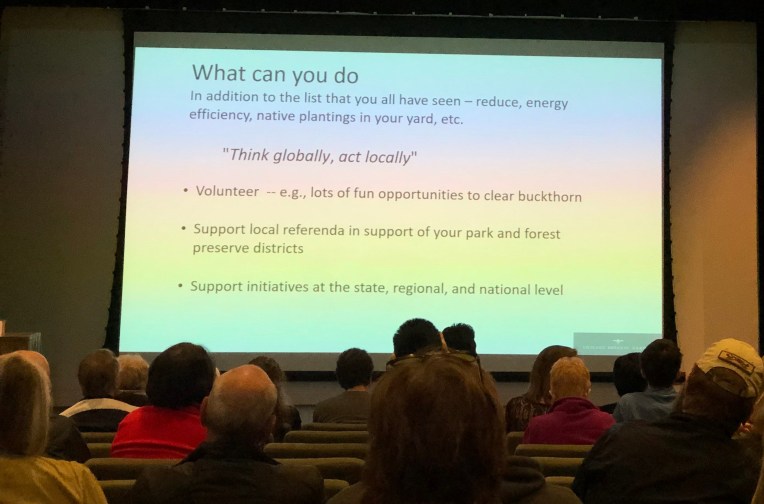
A presentation slide of what we as locals can do to help combat climate change.
Although I have been very interested in environmental issues for a long time (after all, I am vegan), I was very frightened and upset after hearing about the state of our environment from experts whose work is focused in different environmental areas. As directly stated from Horton, “We could be a leader on this front, mitigating climate change. But we are not, and it is totally depressing.” However, this whole discussion allowed me to consider what responsibility I have to reduce the rate of climate change.
In CST class, we learned how to ethically reason through various situations, and I think the way we approach environmental issues should be modeled by these principles. According to Richard Paul and Linda Elder’s Ethical Reasoning, there are many egocentric perspectives that we should not possess. Some of these perspectives include egocentric blindness, the tendency to not notice facts, and egocentric oversimplification, the tendency to ignore important issues in favor of other outcomes that support our beliefs (7). If we hold either of these perspectives, we are deterring our ability to grow and change as a country and, in turn, as human beings. It is our ethical duty to recognize the state of the environment and stop perpetuating the actions that cause danger to humans, animal species, and the planet. We must deeply listen to the information around us and change our simple behaviors in order to mitigate climate change.
As a member of society and an inhabitant of Earth, I believe that we must do all we can to maintain the longevity of species existence and our interaction with the earth. This may include taking shorter showers, eating vegan, writing a letter to a congressperson, protesting, investing in sustainable companies, or even running for office to implement decisions of our own. No matter the magnitude of the action, it is important that we all take a look at how we currently live our lives and work to make a change either within ourselves or on a larger stage.
Overall, I felt that the panel on climate change was incredibly thought provoking and informative. I highly recommend this experience to future CST students when it returns next year.
 Sami's Social Speculation